
Sound Breath Toolkit
At its core, the Sound Breath Toolkit (SBTK) is an invitation to breathe smarter, listen deeper, and reclaim the body’s built-in tools for calm, vitality, and balance—no wasted breath required.
Created for turbulent times, SBTK honors the body’s innate intelligence and capacity for self-regulation. The practices are designed to be accessible, adaptable, and easily woven into daily activities—walking, resting, exercising, or preparing for sleep—so calm and balance become lived experiences, not abstract ideas.
The Pillars of SBTK

Breath
SBTK paces the gentle breath with a ratio of 1:2, exhaling twice as long as we inhale. We encourages 4-counts of inhalation and 8-counts of exhalation, always through the nose. This smart breath, ENE, is shorthand for extended nasal exhalation.
Include ENE with your daily activities.

Movement
Movement stimulates the release of hormones and neurotransmitters. Endorphins, serotonin, and dopamine are just a few biochemicals that help reduce anxiety and depression. They also help our bodies achieve and maintain nervous system regulation.
Pick 1-2 SBTK Exercises each day.
Sound
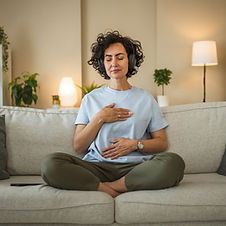
Humming with the exhale allows you to stretch your four counts of inhalation into eight counts of exhalation.
We actually use less air sounding than when breathing silently. Sound also tonifies the vagal nerve by vibrating in your throat.
Hums are a shelf for your exhalation.
More on Movement and Sound
Movement
Beyond the hormone release already mentioned above, movement plays a specific role for anxiety and trauma. A 2015 systematic review by Stonerock, Hoffman, and Smith found that exercise produced anxiety-reducing effects comparable to established treatments for some groups, and greater than placebo, across 12 randomized trials. For trauma specifically, Rosenbaum and colleagues (2015) found that physical activity produced a small-to-moderate reduction in PTSD symptoms compared to usual care, work consistent with the broader idea that movement helps the body complete a stress response rather than stay stuck in it.
None of this requires intensity. Walking, stretching, and easy pacing count. What matters more is consistency and pairing: SBTK doesn't treat movement as a separate technique to master, it's a physical anchor, the thing that helps the 4-count-in, 8-count-out breath–extended nasal exhalation– become automatic enough to carry into daily life, whether you're lying down, sitting, or on your feet.
Sound
Notably, the Vagus (aka the vagabond or the wandering nerve) emanates from the brainstem on its way to the heart, lungs, and digestive organs. While descending through the neck, it gives off the laryngeal nerves that control the vocal cords.
By vocalizing in long, sustained phrases-such as paced humming at about five to six breaths per minute-one slows and lengthens exhalation. This slow breathing pattern has been shown to increase heart rate variability and baroreflex sensitivity-markers of healthy autonomic function. Making the exhale about twice as long as the inhale (1:2) may enhance this calming effect. Combined with other factors, SBTK is designed to shift autonomic balance away from the fight-or-flight reactivity of the sympathetic nervous system back towards a parasympathetic influence of rest-and-restore.
Think of a daily hum on the exhale as vagal floss: a small, repeated action that, over time, may help signal safety to the rest of the nervous system, the same way regular flossing protects your teeth without you thinking much about it. Given that one of the goals of SBTK is to reduce the fight-or-flight response, a sense of safety is paramount. A slow, regular, easy hum sends a message to the rest-and-restore parasympathetic NS that slow and regular – rather than frantic and chaotic – is good and safe.
The breath is the main actor in this process, and sound plays a very important role in supporting the breath. How can we exhale twice as long as we inhale? Where does the extra breath come from? It comes from the making of sound; we actually release air slower when making sound through the nose with our lips closed. Sound becomes a proverbial shelf for the breath to ride upon when we hum. Sound provides the method for a slower use of the breath. In this instance, we breathe in for 4 and out for 8, a breath ratio of 1:2. We couldn't do this without sound.
For the fuller research behind this, including the entrainment mechanism that explains why a steady, repeating sound calms the nervous system more effectively than random noise, see The Science Behind SBTK.


